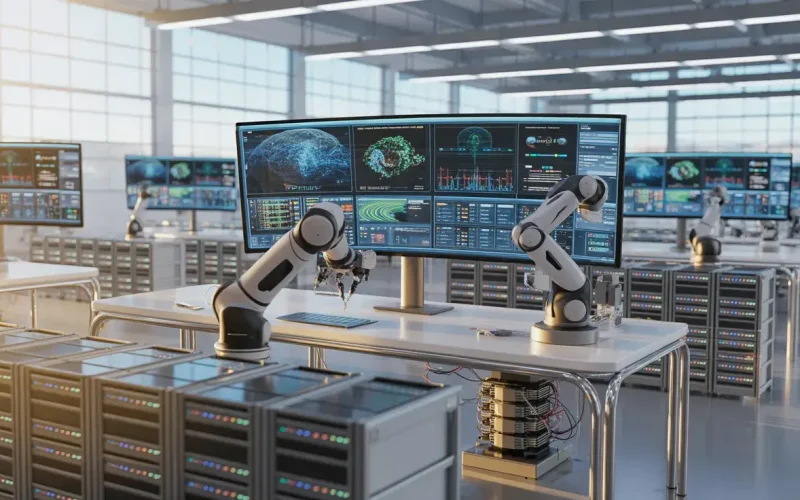
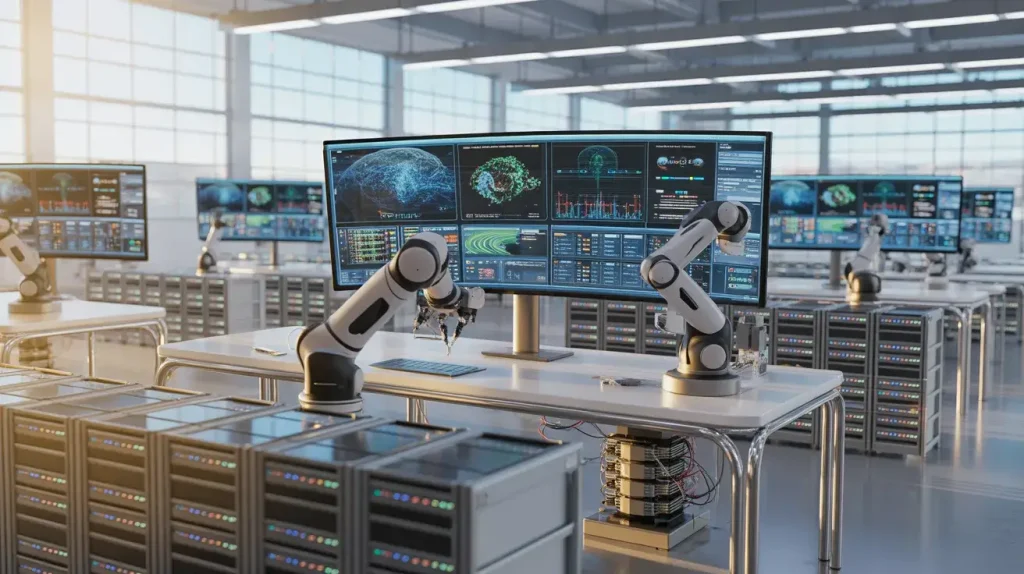
Artificial intelligence is no longer a distant concept from science fiction. Today, machines are learning from massive amounts of data and gradually becoming capable of performing tasks that once required human intelligence. From voice assistants and recommendation systems to autonomous vehicles and advanced medical diagnostics, AI is quietly reshaping the world around us.
What makes this transformation fascinating is not just the technology itself, but how it imitates aspects of human thinking. Modern artificial intelligence systems can analyze patterns, make predictions, and even improve their performance over time. This ability to adapt and learn from information has opened the door to innovations that were unimaginable just a decade ago.
In this article, we will explore how data drives machine learning, the technologies behind this progress, real-world applications across industries, and what the future of artificial intelligence might look like.
Content
What It Means When Machines Are Learning
When people hear that machines are learning, they often imagine robots suddenly becoming intelligent overnight. In reality, the process is much more systematic. Machines learn by analyzing large sets of data and identifying patterns within that information.
This learning process is powered by machine learning technology, which allows computers to improve their performance without being explicitly programmed for every scenario. Instead of following rigid instructions, algorithms study examples, detect trends, and refine their predictions.
For example, an email spam filter becomes more accurate over time because it learns from thousands of messages. It identifies patterns in spam emails and adjusts its rules accordingly. This is a simple illustration of AI learning algorithms in action.
Over time, these systems become increasingly sophisticated, enabling computers to perform complex tasks such as language translation, medical analysis, and financial forecasting.
How Machines Are Learning: Machine Learning Explained in Simple Terms

To understand how machine learning works in simple terms, imagine teaching a child to recognize animals. You show pictures of cats and dogs repeatedly until the child learns to tell the difference.
Machine learning follows a similar process.
A computer is given large amounts of labeled or unlabeled data, and algorithms analyze this information to discover patterns. Once the system identifies these patterns, it can apply them to new situations.
There are several common approaches used in machine learning:
Supervised Learning
In supervised learning, the system learns from labeled examples. For instance, if a dataset contains images labeled as “cat” or “dog,” the algorithm learns to classify new images based on those patterns.
Unsupervised Learning
Here, the algorithm works with unlabeled data. It looks for hidden structures or groupings within the dataset. Businesses often use this method to discover customer segments.
Reinforcement Learning
This approach involves trial and error. The system receives rewards for correct decisions and penalties for mistakes. Over time, it learns the most effective strategy.
These methods are the foundation of modern intelligent automation, allowing machines to handle increasingly complex problems.
Technologies That Allow Machines to Learn
Behind every intelligent AI application lies a combination of powerful technologies working together. One of the most important is neural networks in AI, which are computational models inspired by the human brain.
Neural networks consist of interconnected layers of nodes that process information. Each node acts like a tiny decision-maker, evaluating data and passing results to the next layer.
When multiple layers are stacked together, the system becomes capable of deep analysis. This approach is known as deep learning.
Deep learning has dramatically improved tasks such as:
- Speech recognition
- Image classification
- Natural language processing
- Predictive modeling
For example, voice assistants like Siri or Alexa rely heavily on predictive analytics and neural networks to understand spoken commands and respond accurately.
These technologies enable machines to move beyond simple rule-based systems and adapt to new data continuously.
Real-World Examples Where Machines Are Learning
Today, real-world examples where machines are learning can be found in nearly every industry. The impact of AI is visible in both everyday applications and specialized fields.
Healthcare
AI systems analyze medical images to detect diseases such as cancer at earlier stages. Hospitals also use machine learning models to predict patient outcomes and recommend treatments.
Finance
Banks rely on AI to detect fraudulent transactions. By analyzing patterns in financial data, machine learning models can identify unusual behavior within seconds.
E-commerce
Online platforms like Amazon use recommendation engines powered by machine learning. These systems study customer behavior and suggest products that match individual preferences.
Transportation
Autonomous driving technologies use advanced AI to interpret traffic conditions, recognize obstacles, and make real-time decisions.
These examples show how data is used to improve efficiency and accuracy across many industries.
Industries Where Machines Are Learning and Improving Automation
One of the biggest impacts of AI can be seen in industries where machines are learning and improving automation.
Manufacturing
Factories are adopting intelligent robots that monitor production lines and detect defects automatically. This reduces errors and improves product quality.
Retail
Retail companies analyze customer purchasing patterns to optimize inventory and personalize marketing campaigns.
Agriculture
Farmers are using AI-powered sensors and drones to monitor crop health, soil conditions, and irrigation levels.
Education
AI-driven learning platforms personalize educational content based on student performance, helping learners progress at their own pace.
These advancements illustrate how artificial intelligence systems are enhancing productivity and transforming traditional workflows.
Benefits of Machines Learning in Modern Technology
The benefits of machines learning in modern technology are far-reaching and continue to grow.
Some of the most significant advantages include:
- Improved efficiency – AI can process massive amounts of information faster than humans.
- Better decision-making – Predictive models help organizations make data-driven decisions.
- Enhanced accuracy – Machine learning reduces human error in complex tasks.
- Scalability – Automated systems can handle large workloads without additional labor.
- Innovation opportunities – Businesses can develop new products and services using AI insights.
These benefits explain why many organizations are investing heavily in machine learning technology to remain competitive in the digital age.
Case Study: How AI Improved Customer Support for a Retail Company
A few years ago, I worked with a mid-sized online retail company that struggled to manage thousands of daily customer inquiries. Their support team was overwhelmed, and response times often exceeded 24 hours.
To solve this problem, the company implemented an AI-powered chatbot built on AI learning algorithms.
Initially, the chatbot handled only basic questions, such as order tracking and return policies. However, the system continuously learned from customer conversations.
Within a few months:
- The chatbot successfully handled over 60% of support requests.
- Customer response time dropped from 24 hours to under 5 minutes.
- Human agents were able to focus on complex issues instead of repetitive tasks.
This real-life example showed me firsthand how intelligent automation can improve both efficiency and customer satisfaction.
Challenges and Ethical Considerations

Despite its benefits, AI also presents several challenges.
One concern is data privacy. Since AI systems rely on massive datasets, organizations must ensure that personal information is protected.
Another issue involves algorithmic bias. If training data contains biases, machine learning models may produce unfair outcomes.
There is also the question of accountability. When AI systems make decisions, determining responsibility can become complicated.
Addressing these challenges requires transparency, ethical guidelines, and careful oversight as AI handles increasingly important tasks.
The Future of Artificial Intelligence and Machines Learning
Looking ahead, the future of artificial intelligence and machines learning appears both exciting and complex.
Researchers are currently exploring Artificial General Intelligence (AGI), a type of AI capable of performing any intellectual task that humans can do.
While AGI remains a long-term goal, current developments already suggest that AI will continue to expand into new fields, including:
- advanced robotics
- climate modeling
- personalized healthcare
- scientific research
As computing power grows and data becomes more accessible, machines will become even more capable of solving complex global challenges.
Conclusion
The reality that machines are learning is no longer theoretical—it is shaping industries, improving efficiency, and opening new possibilities for innovation. From neural networks in AI to Intelligent Orientation Control and predictive analytics, modern technologies allow computers to analyze data, recognize patterns, and adapt over time. These capabilities are transforming everything from healthcare and finance to retail and transportation. While challenges such as data privacy and ethical concerns must be addressed, the potential benefits of machine learning are enormous. With responsible development and thoughtful implementation, artificial intelligence can become one of the most powerful tools for solving some of the world’s biggest problems. As we move forward, one thing is clear: the journey of intelligent machines is only just beginning, and the impact of AI will continue to grow in ways we are only starting to understand.
FAQ’s:
What is machine learning?
Machine learning technology lets computers learn patterns from data and improve decisions without being directly programmed.
What are the 4 types of machine learning?
The four main types are supervised learning, unsupervised learning, semi-supervised learning, and reinforcement learning.
What are the 7 types of machine learning?
Seven types include supervised, unsupervised, semi-supervised, reinforcement, deep learning, self-supervised learning, and transfer learning.

David French is an avid tech enthusiast. He loves to read about new innovations and technologies as well as share his thoughts on what he finds. He has a degree in English from the University of South Florida, but spends most of his time writing about technology rather than reading literature.